

Evaluating Blockchain in Finance
Author : Kusum Lamsal
Date: January 18, 2025
Introduction
Web 3.0 is the idea that internet should be decentralised and free from geographical interferences and manipulation.Blockchain is a crucial aspect of WEB 3.0 . It is a decentralized , distributed ledger system that ensures secure and transparent transactions without the need for intermediaries . Initially developed for Bitcoin ,it has expanded it’s domain in other parts of modern society.The core principles of blockchain include immutability , transparency and security ,whuch make it a transformative technology for managing digital assets and ensuring data integrity.
In financial systems it seems promising because:
- Decentralization
- Smart Contracts : the self -executing contracts with the terms directly written into algorithm should enforce agreements reducing middlemans
- No geographical Restriction : This is also a major aspect of blockchain , international transactions can be approached in simple manner
- Enhanced Security : Immutable and transparent nature ensures trust among people and system
How does Blockchain Work
 Figure : Blockchains db diagram .
1. Introduction to Blockchain
- What is Blockchain?
In short Blockchain is a type of distributed ledger technology (DLT) that records transactions in a secure, transparent, and immutable way across a network of computers (nodes).- Analogy The simple analogy of blockchain can be as money record that we collect while playing taas in festives , all are responsible for the authenticity of data and one can’t simply modify that record
2. Ledger
- What is a Ledger?
A ledger is essentially a record-keeping system, like a digital book where transactions are logged.- Analogy: The above example of taas is enough for this , like this is a public ledger and everyone can verify the data authenticity or just observe it , The data can be modified when all involved acknowledge that modifications
- In blockchain, this ledger is distributed, meaning copies of it exist on many different computers, ensuring transparency and redundancy.
3. Immutability
- What is Immutability?
Once data is recorded in a blockchain, it cannot be altered or deleted. This is ensured by cryptographic hashing.- Analogy: the data is being written by all involved parties with dotpen and one can’t simply erase that without everyone acknowledging
- Why is Immutability Important?
It ensures that no one can tamper with the transaction history, making the system highly secure and trustworthy.
4. Decentralization
- What is Decentralization?
Unlike traditional systems where one entity controls the ledger (e.g., a bank or government), blockchain is decentralized. This means there’s no central authority, and everyone involved has a copy of the ledger.- Analogy: Instead of having a single bank manager who records transactions in taas , each person in a group keeps their own copy of the ledger. No one can control the whole system and that’s the main objective.
- This ensures that blockchain is more resilient and less vulnerable to single points of failure.
5. Blocks and Chain Structure
- What are Blocks?
Transactions are grouped into “blocks.” Each block contains a set of transactions, a timestamp, and a reference to the previous block.- Analogy: Think of a block as a page in the notebook, and each page is linked to the one before it. This creates a continuous chain of pages (blocks).
- Why the Chain?
The chain structure ensures that every block is securely linked to the previous one, creating a chronological order of events.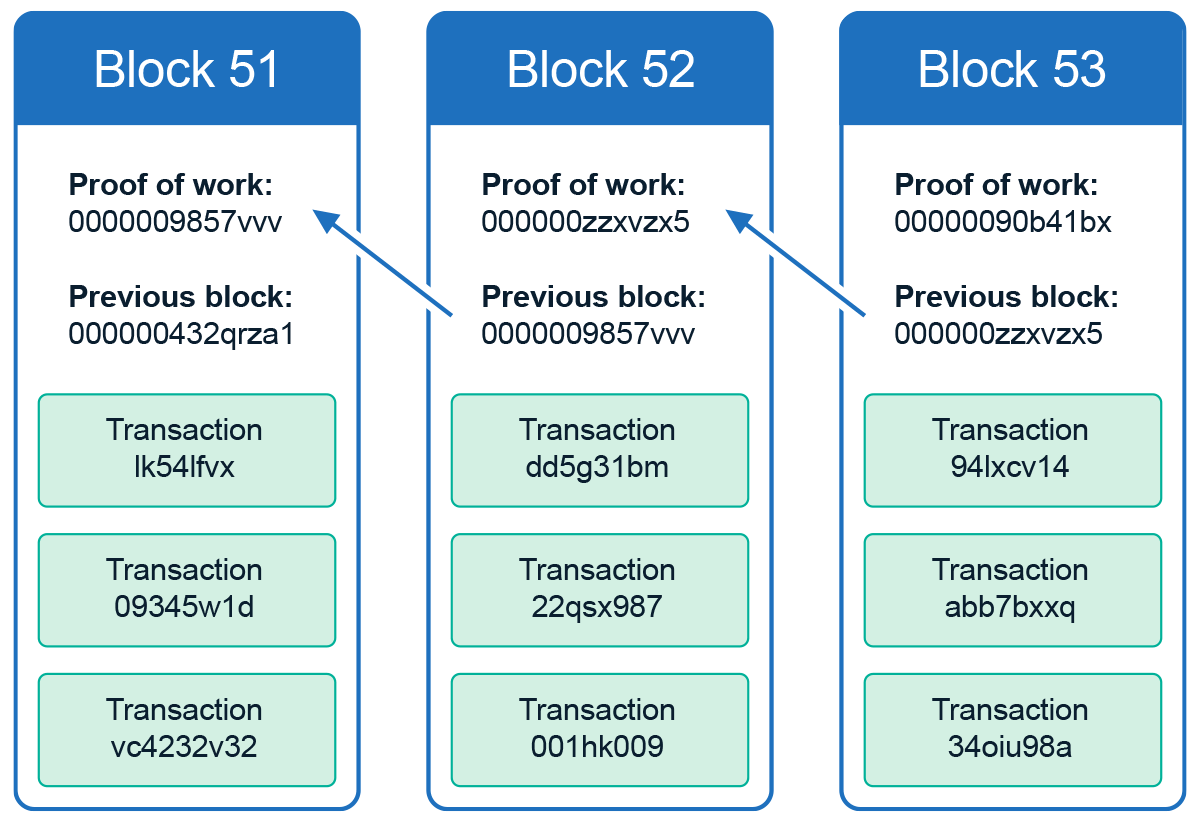 Figure : Chains in Blockchains .
6. Cryptographic Hashing
- What is a Hash?
Each block contains a code called “hash” that is generated by a cryptographic algorithm and it ensures that block’s data hasn’t been altered- Analogy: It’s like a unique strings generated from a whole text , if one word is altered then it will change and other will try for error mechanism.
- The hash of the previous block is included in the next block, creating an unbreakable chain of blocks.
7. Consensus Mechanisms
- What is a Consensus Mechanism?
Blockchain networks rely on consensus mechanisms (like Proof of Work or Proof of Stake) to agree on the validity of transactions. This prevents fraudulent transactions and ensures everyone on the network agrees on the state of the ledger.- Analogy: Imagine in taas game , everyone agrees to the pseudo rule of that game and plays along and everyone acknowledges that and if anyone wants to join the game , should learn the rule and agree. In blockchain miners and validators take part in consensus mechanisms
8. Smart Contracts
- What are Smart Contracts?
These are self-executing contracts where the terms are written directly into code. When predefined conditions are met, the contract automatically executes.- Analogy: Let’s think there is a new hotel where you can eat food but you pay first through esewa and then it acknowledges you by a token and you get the food yourself .
Blockchain In Finance
1.Cryptocurrency
Cryptocurrencies have emerged as a alternative to traditional currencies . One of the key advantage and future prospect of cryptocurrencies is to revolutionize financial transactions by eliminating intermediaries like banks , they can facilitate faster and cheaper cross -border payments which can be typically useful to citizens of countries with volatile currencies and low incomes.Also assets are managed by individual andcannot be altered by middlemens.
example include bitcoins ,ethereum ,and many meme coins
Pros and Cons of Cryptocurrencies in Financial Markets
Pros of Cryptocurrencies in Financial Markets
Decentralization:
- It operate on decentralized networks ,and donot have any central authoririty (NRB or government) Thus reducing the risk of interference and survillence
- Benefit: Greater financial freedom and autonomy for users.
Transparency:
- Transactions are on public blockchains and are transparent and visible to anyone. Once a transaction is recorded, it is immutable and cannot be altered because it is stored in multiple nodes.
- Benefit: This transparency can help reduce fraud and increase trust in the financial system.
Security:
- Cryptocurrencies use strong cryptography to secure transactions and user identities and immutability feature of blockchain reduces the danger of hackers manipulating the system or data
- Benefit: Increased security for transactions compared to traditional financial systems.
Lower Transaction Costs:
- Cryptocurrencies often have lower transaction fees compared to traditional banking systems, especially for cross-border transactions.
- Benefit: Cost savings for both individuals and businesses, particularly for international transfers.
24/7 Market Access:
- Cryptocurrency markets operate 24/7, unlike traditional financial markets that have set trading hours.
- Benefit: Flexibility for investors to trade at any time, increasing market accessibility.
Innovation in Financial Products:
- Innovation in new platforms such as decentralized finance (DeFi) platforms, which offer lending, borrowing, and yield farming services without intermediaries.
- Benefit: More diverse investment opportunities.
Cons of Cryptocurrencies in Financial Markets
Volatility:
- Cryptocurrencies are known for their high volatility, with prices often experiencing significant fluctuations over short periods.This is due to pump and dump scheme of some cryptocurrencies
- Drawback: This can make cryptocurrencies risky for investors, especially those looking for stable returns.
:max_bytes(150000):strip_icc()/bitcoins-price-history-Final3-56d81947a532495ea0b0c3b41e880a8a.png) Figure : Price Fluctuations of Bitcoins.
Figure : Price Fluctuations of Bitcoins.
Regulatory Uncertainty:
- Cryptocurrencies face an uncertain regulatory environment, with governments and financial regulators around the world still determining how to approach their use and taxation which is the antithesis concept of blockchain and It is still illegal in many places to trade cryptocurrencies.
- Drawback: This creates risks related to future legal and regulatory changes that could affect the market.
Lack of Consumer Protection:
- Since cryptocurrencies are decentralized and transactions are irreversible, there is little to no recourse for consumers if they make mistakes or are victims of fraud ,like helpline in traditional banking systems .
- Drawback: Increased risk of loss for users who fall victim to scams or errors.
Scalability Issues:
- Some blockchain networks (e.g., Bitcoin) face scalability challenges, leading to slower transaction speeds and higher costs as the network becomes congested.
Environmental Impact:
- Cryptocurrencies like Bitcoin rely on energy-intensive mining processes that have been criticized for their environmental impact.Cryptocurrencies generate a lot of greenhouse gases and electronic waste (e-waste)
- Drawback: High energy consumption and carbon footprint .

Figure : Environmental footprint of BTC mining across the world (2020–2021).
- Adoption Challenges:
- While cryptocurrencies are growing in popularity, they are still not widely accepted by general population and look with an scepticism.
- Risk of Market Manipulation:
- Cryptocurrency markets can be more susceptible to manipulation due to the lack of regulation and oversight and meme coins and cheap knock off cryptocoins are damaging it’s reputation and adoption.
 Figure : Graph showing Pump and Dump scheme.
- Cryptocurrency markets can be more susceptible to manipulation due to the lack of regulation and oversight and meme coins and cheap knock off cryptocoins are damaging it’s reputation and adoption.
Current Scenario of Blockchain in Financial Market (As of January 18, 2025)
Key Highlights
1. Political Landscape and Regulatory Developments
- United States:
- Donald Trump acknowledging the potential of cryptocurrencies and need for US to be leader is planning to introduce executive orders to reduce government regulatory burdens on crypto companies
- Proposed initiatives include:
- Establishing a Crypto Advisory Council.
- Directing the SEC to rescind costly accounting guidelines for holding cryptocurrencies.
- Ending Operation Choke Point 2.0, which allegedly restricted crypto firms’ access to traditional banking services.
- These actions contrast with former President Joe Biden’s regulatory crackdowns, including lawsuits against major exchanges.
- Europe:
- The Markets in Crypto-Assets (MiCA) regulation came into effect on December 30, 2024.
- MiCA provides a comprehensive framework for digital assets, aiming to:
- Enhance security, transparency, and trust in the crypto market.
- Require providers to register and obtain authorization within the European Union.
- Reduce systemic risks and promote market stability.
2. Institutional Adoption and Market Dynamics
- Institutional Interest:
- Pension funds have begun exploring investments in digital assets after substantial market rallies.
- Examples:
- The State of Wisconsin Investment Board and Michigan invested in regulated ETFs, such as:
- BlackRock’s Bitcoin ETF.
- Grayscale’s Ethereum ETF.
- The State of Wisconsin Investment Board and Michigan invested in regulated ETFs, such as:
- This indicates growing acceptance of cryptocurrencies in traditional financial portfolios.
3. Challenges and Considerations
Regulatory Uncertainty:
- Lack of clear frameworks in many jurisdictions poses risks for innovation and rapid development without much study and analysis from government has caused this.
Scalability Issues: . -Blockchain by definition is decentralized and hardware infrastructure to support this isn’t well evolved properly as the rise in cryptocurrencies causing scalability issues
Integration with Legacy Systems:
- Significant changes to technology and workflows are needed to integrate blockchain into existing systems.
- These changes will be heavy and it is to be observed how this will take place.
Current Scenario of Blockchain in Nepal’s Financial Market (As of 2025)
Key Highlights
1. Political Landscape and Regulatory Developments
Cryptocurrency Legality:
- Nepal Rastra Bank (NRB), the central bank, has declared all trading including cryptocurrencies as illegal
- The government has not established provisions for their legalization, and all kinds of transactions related to cryptocurrencies are prohibited in Nepal.
Regulatory Actions:
- In response to growing crypto frauds, the Financial Intelligence Unit (FIU) of Nepal has proposed enhancing scrutiny of crypto transactions and conducting public awareness campaigns.
2. Institutional Adoption and Market Dynamics
Blockchain Initiatives:
- Despite the ban on cryptocurrencies, Nepal has explored blockchain technology for other applications.
- The Rahat pilot program, conducted in partnership with the Jaleshwor Municipality, UNICEF Office of Innovation, UNICEF Nepal Country Office, and the Rumsan team, aimed to enhance humanitarian aid efforts through blockchain-based digital cash and voucher systems.
Financial Inclusion:
- The United Nations Capital Development Fund (UNCDF) has expressed interest in leveraging blockchain for financial institutions
3. Challenges and Considerations
Regulatory Uncertainty:
Infrastructure and Awareness:
Use of Blockchain and decentralized internet in parts of world
Blockchain Applications in Nepal and Other Countries (As of January 18, 2025)
Nepal
Humanitarian Aid:
- The Rahat pilot program, in collaboration with Jaleshwor Municipality, UNICEF Office of Innovation, UNICEF Nepal Country Office, and the Rumsan team, utilized blockchain-based digital cash and voucher systems to enhance humanitarian aid delivery.
Financial Inclusion:
- The United Nations Capital Development Fund (UNCDF) has explored leveraging blockchain technology to improve financial services delivery in Nepal, aiming to enhance financial inclusion for underserved populations.
Global Applications
Estonia:
-Estonia has intergrated blockchain in it’s government operations : healthcare records , judicial systems and legislative process
cryptoreference
blockchainSwitzerland:
- Known as the “Crypto Valley,” Switzerland has fostered a supportive environment for blockchain startups through grants, tax incentives, and access to venture capital, attracting blockchain entrepreneurs and investors globally and proper IT acts that safeguards both parties. reference
United Arab Emirates (UAE):
- The UAE government has implemented blockchain technology to enhance data integrity and information security in government operations including supply chain tracking and vital details of it’s population reference
Conclusion
In conclusion , blockchain tech is transforming financial systems worldwide in one aspect while other one is looking with scepticism about this new tech , The problem currently is that the tech is evolving very rapidly and we need to acknowledge this and adpat with the technology , The technology is not currently afforable to generalise the blockchain technology and strong inter government initiative is required to address the both pros and cons of this new technology